Episode Transcript
[00:00:00] Sarah Diop: You're listening to the Wild Woman with Sarah Diop. Remembering your wild one episode at a time.
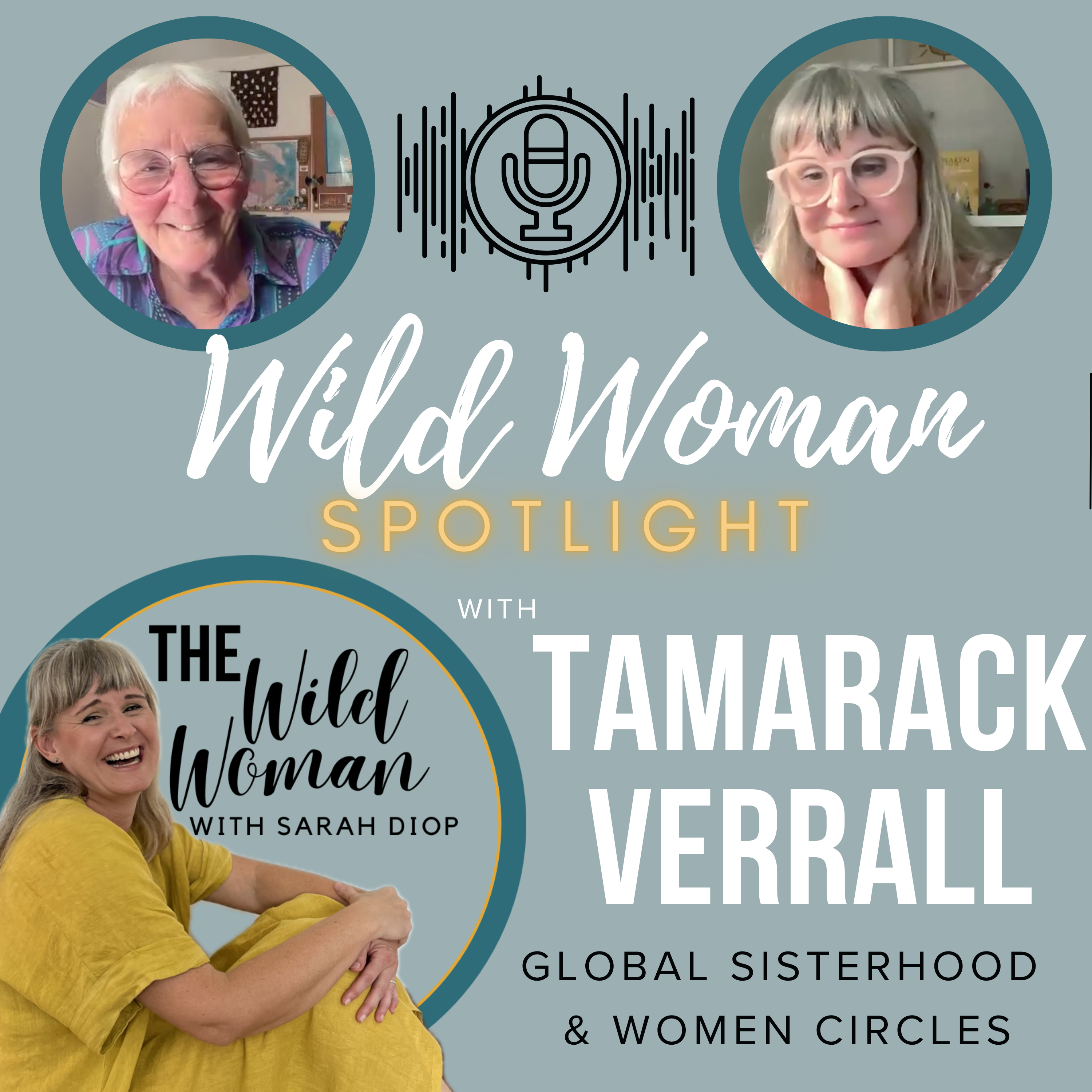
Welcome to the Wild Women Spotlight. On this episode, we're shining our spotlight on Tamarack Verrall.
She's going to talk to us a little bit about communities of women and women's circles. Hi. Thanks so much for being on the show.
[00:00:24] Tamarack Verrall: It's wonderful to be invited.
One of my favorite topics of all.
[00:00:28] Sarah Diop: That's so great.
So we met because of a community called World Pulse. And if you're out there listening and you don't know it, it's an amazing community for women. I joined, let me think, 2010 when it first came out and had a magazine. Did you know that it used to have an actual hardcover magazine?
[00:00:49] Tamarack Verrall: I have a few of the originals.
[00:00:51] Sarah Diop: Yeah, me too. That's how I found them. So I saw that You've joined since 2014. It's an online community where women get to share their stories.
And you reached out to me because. An article I wrote on WorldPulse, and then we started communicating a little bit over email. How did you discover WorldPulse?
[00:01:13] Tamarack Verrall: A friend of mine sent me the information. She said, I bet you'd be interested in this, and gave me some of the first magazines.
[00:01:22] Sarah Diop: Amazing.
[00:01:22] Tamarack Verrall: They knew it would be just dream come true for me. Like global sisterhood. Yes.
[00:01:28] Sarah Diop: Yeah.
[00:01:29] Tamarack Verrall: It's amazing.
[00:01:30] Sarah Diop: Yeah. And there's people from all over the world. I would highly recommend anyone who wants to reach out to a global sisterhood, like you said, to check out that app or on their website. Yeah. So you've been in the women's movement in Canada since the 1960s.
So what drew you to that kind of work in the first place? And how has the women's right movement changed, morphed over the years since the 60s?
[00:01:58] Tamarack Verrall: Well, what drew me into it was the way women that I knew and that I knew of were being treated by men.
[00:02:05] Sarah Diop: Yeah.
[00:02:06] Tamarack Verrall: And I think that one of the first things was discovering that one of my childhood girlfriends who was shy and not really able to speak out had been raped.
And just to know that somebody so sweet, anyone could be violated. And becoming more and more aware of the number of women who were being violated that got me jumped into the women's movement. Wow.
[00:02:34] Sarah Diop: How do you feel about the progress we've made since then?
[00:02:37] Tamarack Verrall: Oh, it's astounding. I'm going back to the 60s and early 70s when it was really a unique opportunity to be sitting in a circle of women and talking about, why is this happening? What can we do about it to what we have now with being connected globally with each other, with what is happening everywhere in the world and what women are doing about it, and how we can strengthen each other's work by the connection that we have, even. Even just by sending a message like, what you're doing is amazing. Keep going. But even beyond that, now we're able to. To really deeply connect and be working together in a lot deeper ways than that.
[00:03:18] Sarah Diop: Yeah. I think also for me, being a little bit younger than you, the MeToo movement was amazing. I think that it really gave a lot of women the opportunity to let people know, like, this isn't uncommon. The amount of abuse is systematic. And I think that it gave a real spotlight to the women's movement, especially for the younger generations. I think they're really.
Especially Generation Z, the women in that generation, they're just not willing to put up with. Statistically, they're showing that they just would rather not get married or date unless they're treated with respect and quality and kindness, so.
[00:04:03] Tamarack Verrall: Well, that's wonderful to hear, and I agree that it's just so wonderful to be coming across the stories or meeting young women who are just standing up for themselves and for having absolutely no patience at all, for being treated in the way that was and unfortunately still is in many areas, still happening. But, yes, more and more young women just saying, not going to put up with that and having the courage to speak out. Having the strength to speak out.
[00:04:37] Sarah Diop: Yeah.
So something I read on your World Pulse profile, so I'm just going to quote you. It says, from my teenage years, my purpose in life has been to speak out about what's being done to us women and to work for change.
What did it look like for you as a young woman in the 1960s? Like, what did that energy feel like back then?
[00:04:58] Tamarack Verrall: Well, that takes me back to one of my first fights when I was a lifeguard when I was 16, and they were going to hire a younger lifeguard man to be the assistant manager of a swimming pool. And it was my turn, and I fought it and won.
[00:05:15] Sarah Diop: Good for you.
[00:05:16] Tamarack Verrall: I did have the support to have the manager who was a man, but that was my first battle. I was already pretty aware that there were women who were fighting this battle before, as I was growing up, to experience the city fathers coming and making sure that I knew how to keep the pool clean and just ridiculous things. Yeah. That was my first battle to break into being the first female assistant manager of a swimming pool in my area.
[00:05:47] Sarah Diop: Yeah. I think that we've all. We all have these battle stories about workplace. I think it's still happening, but I feel that it is getting better.
[00:05:56] Tamarack Verrall: Yeah. At that time, my mother had to fight to have a bank account, and she had six children with no access to money for emergency care because she didn't have access to a bank account. She was also forced to carry a dead baby because they wouldn't allow her an abortion. And she already had five children. Not that that should even matter. But I did grow into my adulthood with parents and other adults who encouraged me to believe in myself.
[00:06:27] Sarah Diop: Right.
[00:06:28] Tamarack Verrall: And to believe that there were things happening in the world that needed changing. But we were still grasping at little bits of news of women who were publicly demanding respect for women and girls.
[00:06:41] Sarah Diop: Yeah.
[00:06:42] Tamarack Verrall: Seeing what was happening to my mother and her generation as I was moving into my adult years was a big part of it.
[00:06:48] Sarah Diop: Yeah. I'm sure.
[00:06:49] Tamarack Verrall: So catching a wave that women older than me had already started to make public.
[00:06:54] Sarah Diop: Yeah.
You've worked across Canada.
Correct me if wrong. I have. Vancouver, Ottawa, Montreal. You even worked in the prison for women with the Elizabeth Fry Society.
[00:07:05] Tamarack Verrall: I did.
That was a wonderful chapter for me. I was with them for 10 years. They did create a position for me to be able to go into the prison for women and meet all of the women in there and find out what had happened to them and what they needed to be able to get out and stay out of any kind of trouble. I absolutely loved having that job and being able to meet them all and be able to set things up for them before they got out so that they could avoid the men who had got mostly usually the men who had dragged them into some kind of illegal activity and get them forgiving themselves for anything that had happened and starting a new life. Yeah. Met a lot of women really struggling and saw them into a whole new strength. And that was wonderful.
[00:07:57] Sarah Diop: Yeah. So it makes me think just this year, Canada passed a law about coercive control. And I think that's exactly what you're talking about. I think recognizing that some of these women might not have actually been accomplices, but being controlled by someone, by an abuser, really.
[00:08:15] Tamarack Verrall: Oh, very much. Being set up, usually by boyfriends or some man in their lives or. It was also.
I'll never forget hearing from one woman that she was asleep in the back of the car when her boyfriend was robbing a bank.
[00:08:29] Sarah Diop: Right.
[00:08:29] Tamarack Verrall: So they just. The fact that she was on the scene and the courts weren't going to listen to her.
[00:08:35] Sarah Diop: Yeah.
The reason I had you come on the show is because when we were emailing back and forth, you mentioned that you led women's circles and that you found it life changing. If you could describe the transformation you saw in the circles and how that particular form of connection helps women transform.
[00:08:57] Tamarack Verrall: It certainly does. A small group of us opened one of the first women's centers in Montreal, and we immediately started circles there.
Right. And the. The power of sitting in a room together and hearing from everybody what their lives have been, what their dreams are, what's been holding them back. I really, really believe in the power of a circle, of a discussion circle with women where we feel totally free to speak and to describe our lives as women and not be told we're selfish to be taking the time or to be shut down by a man who thinks that what he has to say is more important.
Yeah.
[00:09:42] Sarah Diop: Or the mansplaining.
[00:09:43] Tamarack Verrall: The mansplaining, yes.
[00:09:47] Sarah Diop: No, I agree. I think that women's circles, no matter how small or large, if you get together with women, I mean, for me anyway, I have women come over. I call it coffee time, but it's just a group of women.
We have coffee, I bake something for us, we pull a couple cards. And honestly, even the ones that just start coming for me, the cards help become a catalyst where all of a sudden people are sharing things they're struggling with. And it doesn't matter how small or big, everyone leaves feeling like they have a support system behind them and somewhere to go when just life feels, you know, we're all trying to, like, do it all and hold it all together and be there for everyone.
For me, I think women's circles give women opportunity to be seen outside of what they do or how they contribute to everyone else's lives. It's just about that one person.
[00:10:46] Tamarack Verrall: Yeah. I matter. As a woman, I. I matter.
[00:10:49] Sarah Diop: Yeah.
[00:10:50] Tamarack Verrall: Yeah. The circles that I've done have very much been on healing from violence that's been done. And so just knowing that the violence shouldn't have happened, or I was punished for being too strong, or this is a battle that's been going on for centuries. It's not this way everywhere. It could be different. In some places, women are respected. Very few, but there are places and that the women's movement is about respecting women. The circles on whatever topic we're on are just so powerful because, you know, you're not alone. You're understood and you learn and you form a heart bond, which is just so tremendous.
[00:11:33] Sarah Diop: Yeah, yeah. Never underestimate the women who wrote women, who run with the Wolves. Clarissa Pinkola Estes. She said something like, don't underestimate the power of a women's group. They can take on the world. And I really feel like that that's paraphrasing, obviously. I really think that. I think that also, women, you're allowed to be unfiltered. I think a lot of times we feel like we're filtered because we're trying to fit in or not aggravate people or whatever. Especially people that are going through like. Like you were saying, the controlling. Like the women that are in situations of control or abuse. It allows, say, especially. I mean, I have friends and family members with the gaslighting that you're just checking in. If you have a women's circle, you can say, is this normal? Or did I get that wrong? And it's like, no, you're not overreacting.
Having emotions about this thing is normal. You know, it helps normalize their feelings and emotions, too. I think, especially like you said, you're doing with abusive groups, women who are abused, they're really confused of what's up or down.
So having other women being like, no, no. Yep. That was crazy.
That's crazy. You're not crazy. That was crazy. Yeah.
[00:12:54] Tamarack Verrall: It's a powerful transformation and just that realization that. Yeah. Being done to you and that it happens to others and that there's a way through it, that it wasn't your fault, whatever it is.
Yeah. Circles of women having the freedom to speak and without being interrupted. Because in a. Generally in a circle, women are pretty quickly interrupted.
[00:13:19] Sarah Diop: Yep.
[00:13:20] Tamarack Verrall: To hear each other and to know each other's stories and to be able to carry each other's stories and to say, I know what I'm talking about. I've heard it from 10 women already within the last few days.
[00:13:34] Sarah Diop: Yeah. Another special thing about women's circles is women's circles could be, like, filled with hysterical laughter to, like, sobbing tears. You know, they can go like this within the same group. I feel like it just feels like a hug you finally get to release.
Because, you know, something I said before we started recording is meeting the be small. And I think the women's circles allow women to be as big as they want. If that means hysterically crying, that's okay. Or hysterically laughing, that's okay, too. You know, instead of us having to be this. Even polite people get to be whatever they want to be.
[00:14:11] Tamarack Verrall: You know, we get to be ourselves.
[00:14:14] Sarah Diop: Exactly. We just get to be ourselves. Yeah. It's a beautiful thing. So one of the things is you wrote Also on your old post, celebrating thousands of women discovering how beautiful they are. I really like that that you said that. Can you share a little bit about what that looks like over the years? Maybe something that, you know, that a woman that's listening could do to kind of reach that realization or to discover their authentic, beautiful self?
[00:14:40] Tamarack Verrall: Well, I think that is the power of circles, because it is so hard for us as women. You know, we're taught so early that we're very selfish if we think anything good of ourselves. But to have this circle and even go around the circle and have other women in circle tell the woman what they see in her is a wonderful thing to do. And then she can respond with, yeah, I do love to paint or whatever it is, or, I like being strong. That's why I swim. You know, to have an audience that cares about you and that isn't trying to silence you and make you smaller. A talking circle of women is a powerful thing.
[00:15:21] Sarah Diop: No, I agree. When you were talking, it made me think. So when I first started doing my circle of women at my home, so I like to bake. So when they came over, they're like, oh, my gosh, you're so good at baking. And initially, I would always be like, oh, yeah, yeah, it was fine, but it wasn't perfect. And immediately. And then it got to a point, because being in the women's circle, you get more confident. And when I would do that, some of the women in women's circle, they don't do that. You're amazing at baking. Do you know what I mean? So I think. Yeah, that's what made me think of when you said that, because it's true of. I would say I unconsciously downplay compliments.
Not knowing. Now I catch myself. I'm like, no, own that. Yes, I'm good at that. Period.
Just. Thank you.
[00:16:08] Tamarack Verrall: Yes. Thanks for saying it. Yeah, I do love to swim or whatever it is.
[00:16:12] Sarah Diop: Yeah, no, that's true. Yeah, yeah, that's very true. Instead of being like, well, it could be better, I guess I'm. It's okay, right?
[00:16:20] Tamarack Verrall: Amazing how women have been taught to belittle ourselves and that we're considered to be aggressive or selfish.
[00:16:31] Sarah Diop: Oh, you're so arrogant. Yes, I am good at baking. Like, no, I am.
I am actually good at baking, period.
[00:16:38] Tamarack Verrall: My skills. Right.
[00:16:40] Sarah Diop: I'm good at that. Thank you.
[00:16:42] Tamarack Verrall: Yeah, yeah. We're. We're supposed to be always subservient and serving others.
And so any confidence in ourselves, any of our own skills that we put forward were immediately Judged for even believing that we are anything.
[00:17:02] Sarah Diop: Yeah.
[00:17:03] Tamarack Verrall: But I think those of us who've had the, the good fortune to be in the women's movement or in women's circles, that's one of the most healing parts of it is being encouraged by others to be as strong as we are and as capable and as brilliant and as forward thinking and also as, as devastated as we are from whatever has happened to us too, that, that in these circles we can just really be ourselves.
[00:17:33] Sarah Diop: Yeah, yeah.
You mentioned the women's movement again, and I wanted to ask you, what do you think is the most important shift that's happened in the women's movement over the last 50 years?
[00:17:46] Tamarack Verrall: Last 50 years?
Well, we've grown now, especially with technology, we're able to be in touch with each other.
[00:17:54] Sarah Diop: Yeah.
[00:17:54] Tamarack Verrall: And you and I both know about World Pulse, which puts 80,000 of us from 227 countries together.
[00:18:03] Sarah Diop: Yeah.
[00:18:04] Tamarack Verrall: Being able to confer with each other and find ways to be of support to each other and discuss what's the next step with each other and to be able to do that on a global scale. The only way I, I continue to think about it is dream come true for me.
[00:18:21] Sarah Diop: Yeah.
[00:18:21] Tamarack Verrall: We're able to do this now. You know, having lived a lot of my adult life pre computer, it's all just incredible to me that we can be in touch directly with each other globally on what's our next step, what can we do with and for each other to make it happen is.
[00:18:39] Sarah Diop: Yeah.
[00:18:40] Tamarack Verrall: Fabulous.
[00:18:41] Sarah Diop: It really makes us have more freedom, the communication, the capabilities. Now you can find your people, you can find your people anywhere. And you don't actually have to be in the same geographic, you know, within a walking distance or a phone call from each other, you know, like.
[00:18:59] Tamarack Verrall: And with the communication that we have, those of us who are able to actually be online with each other, that we're able to take it back to women in communities who've never been online and don't know that it's happening and connect those small individual discussions to the global discussion that's happening.
[00:19:19] Sarah Diop: Yeah.
[00:19:20] Tamarack Verrall: Because like you and I and 80,000 of us are now online together.
[00:19:25] Sarah Diop: Yeah. And the smartphone. Right. The phone makes it so much easier for people, even in remote places. I mean, in Senegal, I live in a smaller place. Most people can have a phone.
Women are able to connect so much easier.
[00:19:40] Tamarack Verrall: Yes. And we know from our global connections that women with phones are also reaching all kinds of women who don't have phones.
[00:19:47] Sarah Diop: True. No. Yeah, that's true. Yeah.
[00:19:50] Tamarack Verrall: We, we live in an amazing time.
[00:19:53] Sarah Diop: Yeah, I think you're right. I think that's the. The biggest advancement.
Knowledge and community and.
[00:20:00] Tamarack Verrall: And being able to connect.
[00:20:02] Sarah Diop: Yeah.
Yeah. Being able to connect. That's amazing. Yeah. If you could give some of our listeners advice, if they're just kind of starting to begin that journey of waking up to maybe some systems that are holding them back, whether it's in their personal life or in their community, in their country, in their workplace. Is there any advice you would give someone if they're just beginning their journey of, like, say, waking up?
[00:20:29] Tamarack Verrall: First thing is trust yourself, trust your gut, trust your ideas, and then find others around you. Whether you find them online or you find them in person. Find other women who are in the same way of thinking who can support you, because you'll inevitably get backlash and. And push back and so find your circle. Others who believe in what you're doing, because then no matter what you're up against, you know you're not alone. And you know that it's not you. It's the. The patriarchal teachings, the patriarchal forces that have taught so many people just to try to shut you down because you're supposed to be quiet and demure and not have any kind of ideas of what, anything needing to change. Because the patriarchy wants to stay in place.
[00:21:24] Sarah Diop: Yes, it sure does.
It's persistent, let's say that. Very persistent. Just when you think we're moving into an era of harmony.
Yeah, it's very persistent.
[00:21:38] Tamarack Verrall: Unfortunately, we're being led by a half a dozen men who just want to play war with, you know, it just. And based on a money system in which they have the access.
It's so evil. It's so horrible.
[00:21:52] Sarah Diop: It's perfectly evil.
[00:21:54] Tamarack Verrall: Yep. Yeah.
[00:21:55] Sarah Diop: Horrible. There's one other question. What does living wild mean to you?
[00:22:01] Tamarack Verrall: I love that word, wild.
Living wild means living my wild self untamed.
[00:22:10] Sarah Diop: Yeah.
[00:22:10] Tamarack Verrall: Breaking rules, definitely.
And wild.
I love nature, and I get myself into the woods or by lakes or into nature as often as I can because that's where I really gain my strength. I mean, if I'm in my home, I can imagine nature as I'm doing kind of exercises or all the different things I do to stay strong. But if I'm in nature, I'm able to really so easily feel my wild self.
[00:22:40] Sarah Diop: Yeah, I agree. I do, too.
[00:22:42] Tamarack Verrall: Yeah. It just infuses me for my next battle.
[00:22:47] Sarah Diop: Yeah.
Wonderful.
And just one final question. If there's one piece of wisdom you can give to some of the women listening, what would it Be.
[00:22:58] Tamarack Verrall: Believe in yourself. Believe in the purpose that you feel deep down inside. Believe in what you're here to do with your life.
Take the time to develop your strength and your clarity.
Read the works of our herstorians, the. The women who have written the history of women. The Herstory.
I love that it's called the Herstory. I love that, too. To know that it wasn't always this way, that there were times and there are times and places in the world in which women are respected. But above all, to believe in yourself and believe in your purpose, no matter what it is.
Take care of yourself and be as strong as you can be. And know that there is a global sisterhood.
[00:23:46] Sarah Diop: Yeah.
[00:23:46] Tamarack Verrall: Who are working to create a different world for everyone. And join World Pulse.
[00:23:52] Sarah Diop: Yeah. That's what I wanted to say to listeners. World pulse.org I will put a pulse like Heartbeat. Yeah, Pulse. I will put a link in the show notes and I will also put a link not only to World Pulse on your guest page. I'm going to put a little thing that you're a guest on our show and then I'll put that. And then I will also put your profile.
So if listeners want to reach out to Tamarack, you can.
And you just go to sarahdeop.com and go to the Wild Woman tab and then you can see guests from at the Wild Woman Sarah Diop. And then you can reach out, join the community.
[00:24:34] Tamarack Verrall: Yeah. And if you get in touch with me when you join World Pulse, let me know that you found out about here on the show.
[00:24:43] Sarah Diop: That'd be great. Yes, do that. That's wonderful. Thanks so much for being on the show. I'm so glad you came on.
[00:24:50] Tamarack Verrall: This has been a real treat to have a visit with you this afternoon and reach out to everyone who's listening or watching.
[00:24:58] Sarah Diop: Thanks so much.
If you'd like to learn more about today's Wild Woman Spotlight guests, you'll find their details in the show notes below. And if you're ready to dive even deeper, head over to my website, sarahdeop.com and then visit the Wild Women page. There you can explore everything the page has to offer, including a dedicated space for all my Spotlight guests with links to connect to them on social media and explore their products and services.
Thank you for listening to the Wild Woman with Sarah Diop. Remembering youg Wild One Episode at a Time.
Don't forget to like, subscribe and review. Every little bit helps and I'll see you next time.